Some fun additional insurance documents to peruse
This weekend I was lucky enough to see a performance of “Titanique” in Chicago (#TitaniqueChicago #Porchlight) which was, as expected, funny and crude and very much over the top, with outstanding performances all around. If you haven’t heard of the show, it’s the story of the Titanic (really, the movie Titanic) told (very badly) by… “Celine Dion” and her music catalog. I mean, where else will you see the iceberg played by a drag Tina Turner?
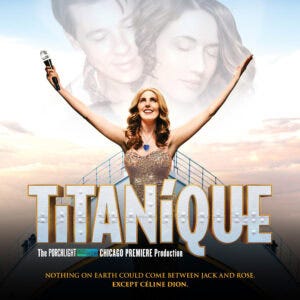
Photo Courtesy of Porchlight Music Theatre
Of course, it got me thinking about the podcast episode I did about the Titanic, and how it was insured, and how all the different insurance products played out.
If you haven’t heard the episode, you can Listen here (or on your podcast player of choice).
Lucky for us, there is a tremendous amount of visual information on the Titanic in the United States National Archives.
Some of my favorite documents in the collection are the claims for reimbursement from survivors. I think these documents tell us so much about the people on the Titanic, especially those people who were in Steerage/3rd class, who we don’t talk about enough.
Subscribe! C’mon, you know you want to….
For every famous person who died on the Titanic, someone died who was not famous at all.
We can start with perhaps one of the most famous survivors of the Titanic, the “unsinkable” Molly Brown.
This is part of her claim to the US Government asking for reimbursement of items lost on the Titanic. While hers isn’t the largest claim, I think she does have the largest jewelry claim.
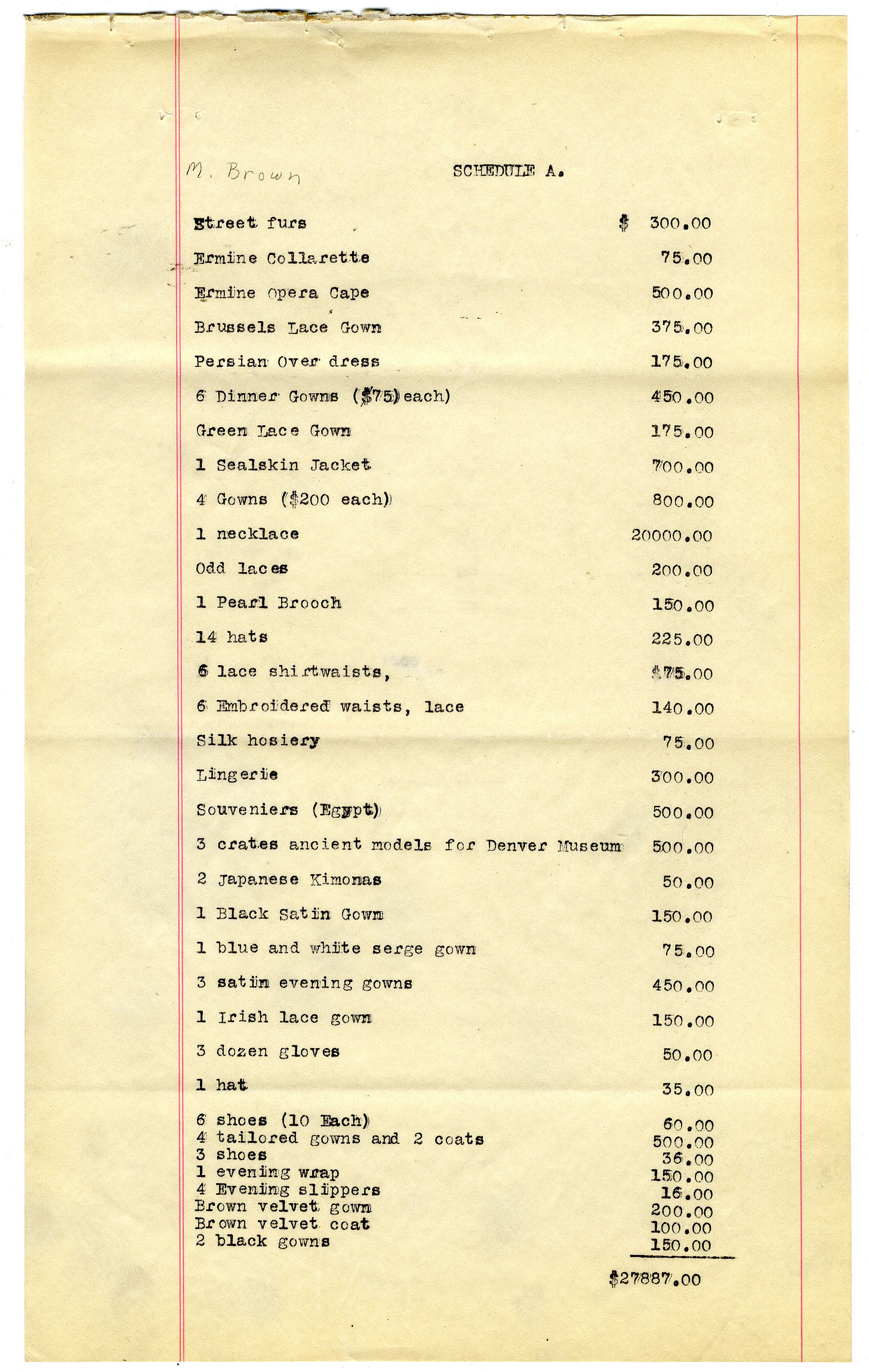
Image Courtesy of the National Archives
It’s worth breaking down some of these because they are so funny—I mean, even that first line item is the intriguing claim for “street furs”—as in, more than one? I guess so, but note that her sealskin (ugh) jacket is valued at quite a bit more than her “street furs”.
Also, she brought A LOT of clothing with her. Consider that most normal (non-rich) women would have had probably three dresses/skirt combos—day, church, and the dress that was downgraded to chores and cleaning. I mean, Molly had 15 hats—I thought it was interesting she listed one separately, at a higher cost than the others ($225/14 = about $16 a hat, and that separately listed hat was valued at $35). That $35 hat is something like a $1000 hat in current dollar value! What does a thousand-dollar hat even look like?
And 3 dozen gloves is a LOT of gloves. I guess in theory, some of them could be gifts since she also brought back a crate of “ancient models for the Denver Museum” valued at $500.
Finally, that necklace—valued at $20,000—something like $637,000 dollars today. It is not, sadly, the “Heart of the Ocean”.
One of the items that was recovered from the wreck of the Titanic was a necklace that was supposed to belong to Molly, but it’s unclear if that was the $20,000 necklace. It was a lariat-style necklace with three gold nuggets, supposedly given to her by her husband. (JJ Brown, her husband, was a mining engineer, and they went from not well off to VERY well off after his part-ownership in a mine hit it big. As a secondary aside, the two of them had been formally separated since 1909 though they never divorced.)
All the pictures of this gold nugget necklace are copyrighted, because the item in question is owned by a hedge fund. (sigh) The fund purchased a collection of Titanic items from an exhibition company, Premier Exhibitions, that went bankrupt. If you look online, you will find a photo of the necklace, but then again you might end up doing what I did and falling down a rabbit hole about this whole hedge fund thing and the fact that Premier Exhibitions has about 10 different “official” websites, none of which work.
I am not sure if the necklace is on display at the Titanic Exhibition at the Luxor in Las Vegas, but those items were all part of the collection purchased by the hedge fund.
Another claim, from a passenger in steerage (3rd class) is just as illuminating in different ways. This is the claim from a male passenger of Chinese descent named Yum Hee.
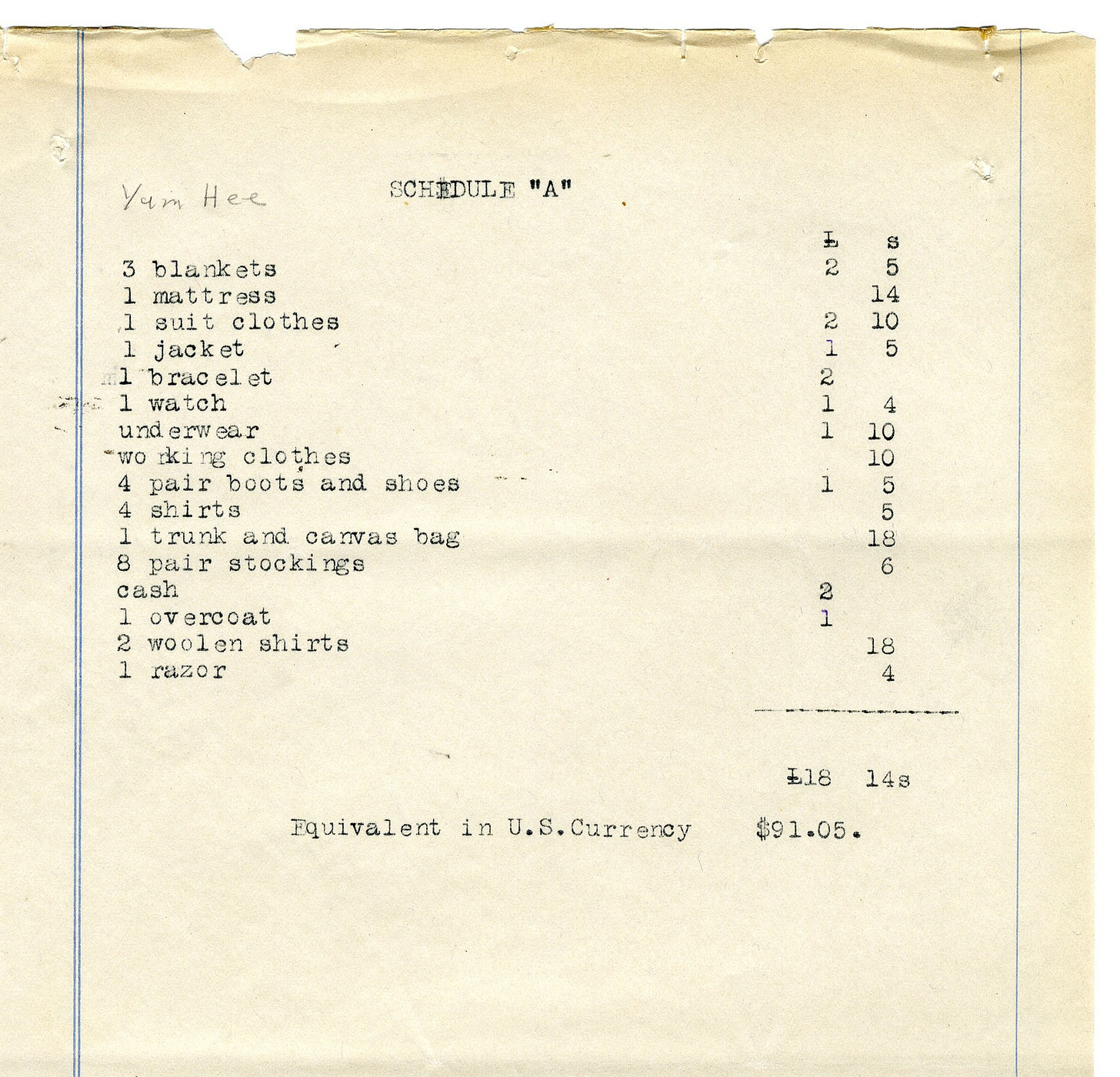
Photo Courtesy of the National Archives
Obviously, we are talking about a very different amount of money here, but it is safe to say that in this case, this was probably the entirety of what Yum Hee owned in this world, and he needed it for his new life in America. I find it particularly interesting that he brought his own mattress.
His list of clothing is more typical—a suit, a few other items, including clothing specifically indicated as “working clothes”. It is interesting that his valuation is in British pounds, not dollars, which is why you see the “L” with the line through it and the “s” in two separate columns.
Unfortunately for Yum Hee, his time in the US was very short. It appears that he was detained by immigration immediately after arriving in New York and then was put on a ship to Cuba. (Remember, the Chinese Exclusion Act was still in effect in the US.) From my research, it appears Yum Hee was sent back to Europe. The last indication of his whereabouts was Kolkata, India. Did he intend to try and immigrate to the US, knowing that the Chinese Exclusion Act was still in force? I’m very curious about this, and I can’t find good answers.
I’ll finish this off with another passenger that was also in First Class but not as famous as Molly Brown: Hamad Assab.
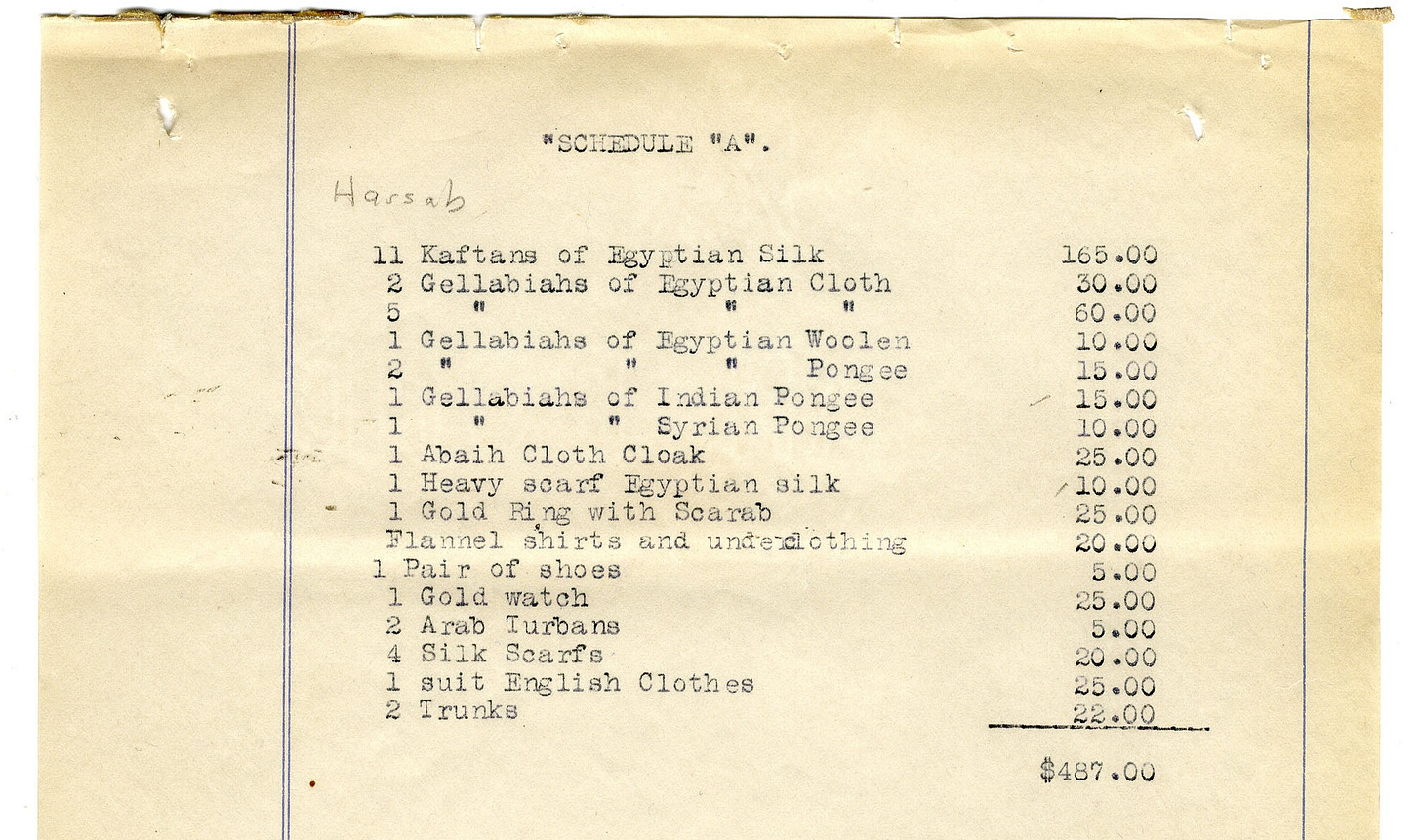
Photo Courtesy of the National Archives
Looking at this, my first guess was that he was a merchant, what with all the kaftans and such he was bringing. (I had to go look up the term “gellabiah”—it’s a traditional Egyptian garment sometimes referred to as a Jellabiya.)
But it turns out he was not a merchant at all. Hamad Assab was the only Egyptian on the Titanic as far as we know, and was apparently travelling as a friend (and possibly the interpreter) of a man named Henry Harper. Henry Harper was the grandson of Joseph Wesley Harper, a publisher whose corporation would eventually become HarperCollins. Henry also has the distinction, apparently, of surviving the Titanic with his dog, a Pekinese. Did you know that three dogs survived the Titanic? I didn’t!
So, all of these items were for his own use, apparently, which marks him as a fairly well-off man—I mean, he has the 1 suit of English clothing, but if you add up all the kaftans and “gellabiahs” he’s got something like 23 outfits with him. (But only one pair of shoes!) After surviving the Titanic, Hamad spent some time in the United States, I assume with the Harpers, and then returned back to Egypt. All I can think of when I see this list of clothing is that he was going to be very cold in New York!
If I’m not mistaken, not all of these claims were paid out in their entirety, but for those people in steerage like Yum Hee, the money was essential for rebuilding their lives. A lot of people on the Titanic also had life insurance policies—at least the wealthier ones, and I’ll probably circle back to show some of those documents at some point, but for now, I’ll just leave you to contemplate what you brought on your last vacation and how it compares.
Later—
Meredith